Many may be familiar with the words "prototype", "test part" and "Q-part", but they have a tendency to be misunderstood. In this article we will try to make it a little clearer what the differences are and when to use the different terms.
What is a prototype?
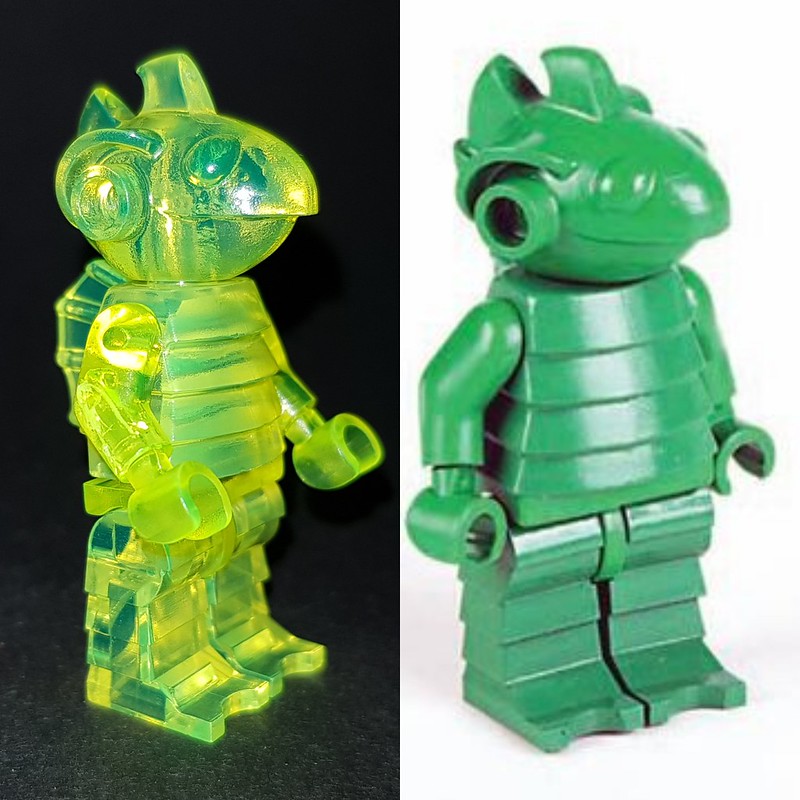
A prototype minifigure alien from an unreleased theme called Seatron.
Let us start with how a LEGO part is made. The two main ingredients needed are plastic and something used to shape the plastic. We are not going to go into very technical details in this article, so we will try to keep it simple. To shape the plastic a mould is used. A mould is basically a metal block with a hole where the plastic is pushed into. Inside the metal block the desired parts/shapes have been carved into the metal. So when the plastic is pushed in it fills up these hollow areas, forming the parts the mould was designed for. The mould is then opened (it usually consists of a top and bottom part) and the plastic parts are then removed fully formed.
When a new part is being designed they can draw it, create it digitally, 3d-print it, or even shape it with something like clay. When the desired shape and design has been acquired they start making a mould. Then they can easily make multiple copies of the part, continue testing, and make them available to set designers if they need them for a set. Making a mould is quite expensive, which is why the part is usually very close to the final form when they start to make it. As the testing and design process continues the part can go through bigger and smaller changes. Eventually everyone are happy with it and and they send the mould off to normal production. At this point it is now a part that you could find in a LEGO set purchased in the toy store today.
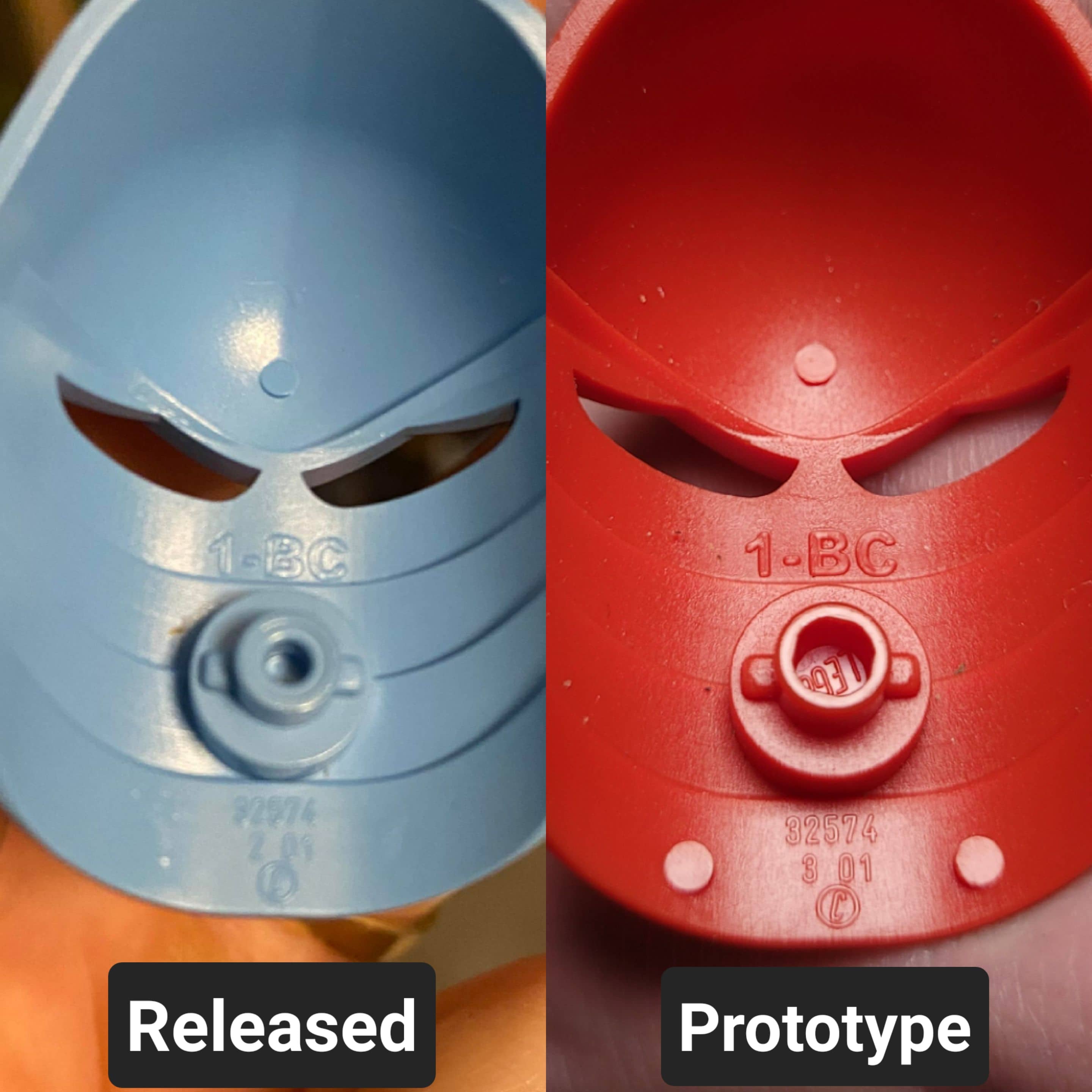
Here is a normal Bionicle mask compared to a prototype mask. Except for the colour only the mouth connection piece is different.
The whole process up until it is cleared for normal production, the part is considered a prototype. To make it easy for us we say that all parts which are different in shape, form or details from the official part are considered prototypes. It could be a small thing like the part having some extra letters on it, to it having a completely different shape and look overall. Sometimes parts never make it past the prototype stage and are never released, they are of course still considered prototypes even though they do not have a released version!
It happens that production parts are made in colours that never show up in sets. Just because you find a part in a colour that seemingly is not available, does not make it a prototype. There has to be something else different with the part for it to be considered a prototype. This is where most people misuse the word, so make sure you keep that in mind. Just a different colour is not enough to be considered a prototype. Take the Bionicle mask on the picture as an example. If the connector piece was not different, only the colour, then it would not be considered a prototype. Instead it would fall under the more generic term "test part".
Test parts
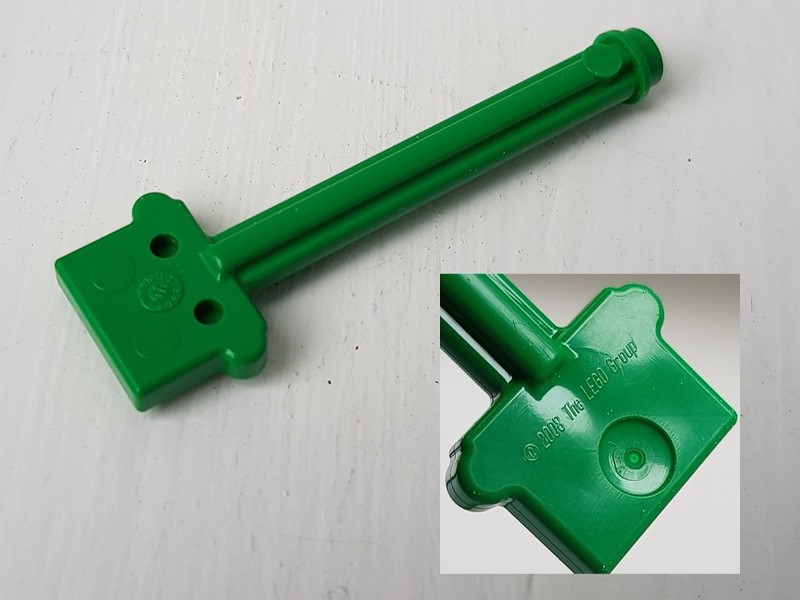
All prototypes are test parts, but not all test parts are prototypes. Test part is a more generic label for all parts made with the purpose of testing something. This could for example be parts made in special colours to look for flaws in the plastic and mould. Or it could be a specific part/tool only made for internal use and testing. A good example of this is the green part on the picture. It is a tool LEGO uses to stick under a brick and see how much friction / clutch power the brick has. This tool has never been officially released to the public or in a set, but it is still not considered a prototype. It is a finished part, made with the purpose of testing.
Q-elements/parts

Q-parts used by LEGO designers and model builders.
This is where the line can become a little blurry. Because not all parts in special colours fall into the category "test part", they may be something we call "Q-parts". A Q-part is LEGO's own name for a part in an unreleased colour, that has been made for model builders and designers. The purpose for these parts is not testing, it is for building, and they are only for internal use.
It can be difficult to differentiate a test part from a Q-part without knowing the part's origin. The colour is usually a giveaway, but it does not need to be. For example, sand green is most likely not a test colour, it is more likely used for a model builder. Red, black, white and trans-clear are more typical colours used for testing. These colours show different flaws in the plastic and mould the best. For example trans-clear makes it possible to see air bubbles in the plastic.
The type of part could also be a giveaway. Model builders tend to use mainly basic bricks and not a lot of speciality parts. So if you find a 1x6 brick in an unreleased colour it is likely to be a Q-part, while a minifigure headpiece is more likely to be a test part.
As mentioned earlier where to draw the line and know what is what can be difficult. However, more often than not a part in an unreleased colour is a Q-part rather than a test part. Q-parts tend to have an easier way out to us LEGO fans than test parts which are usually kept inside secure areas. Sometimes Q-parts can show up for sale in pick a brick shops in LEGOLAND, altough rarely. It is often because the model builders are clearing out little used parts, or making space for new ones.
2x4 test bricks

Some test bricks made by Bayer in Germany in the 1960s.
2x4 bricks have been used for testing since day 1. Some of you may be familiar with the name "Bayer bricks", made by the plastic manufacturer Bayer in Germany. These bricks often have letters on the studs instead of "LEGO", but are indeed LEGO test bricks. Not made directly by LEGO, but by Bayer on behalf of LEGO. Now you may wonder why these bricks are not counted as prototypes, since they are different from released 2x4 bricks. Again it is because these are not made to eventually be released, their only purpose is testing. So these 2x4 bricks are "finished" and are not an early version of a to be released part. There are way more manfuacturers and variations, but this article will not go into detail about that.
Summing up
This article just scratches the surface when it comes to prototypes, test parts and Q-parts. It becomes way more tricky the more you start digging, and the lines can become really blurry. Hopefully this helped you a little along the way though, and if you have any questions feel free to ask!
Did you know that there is an own group and community for prototypes and test parts on Facebook? Make sure to check it out if you find this topic interesting: LEGO prototypes and test parts Facebook group
Have a look at some of the prototypes in our collection: LEGO prototypes collection.
Use the navigation menu on the top of our website to find more reading material or check out some of our most recent articles heres: More LEGO articles
Thanks for reading!
Last edited 26.03.2026